
- New episode of The Green Report spotlights Carnmoney Golf Club in Calgary, Canada
- Club partners with Ducks Unlimited Canada to manage water levels and support waterfowl
- Superintendent Cameron Kusiek and team reveal how an innovative interconnected pond system delivers healthier turf and thriving habitats
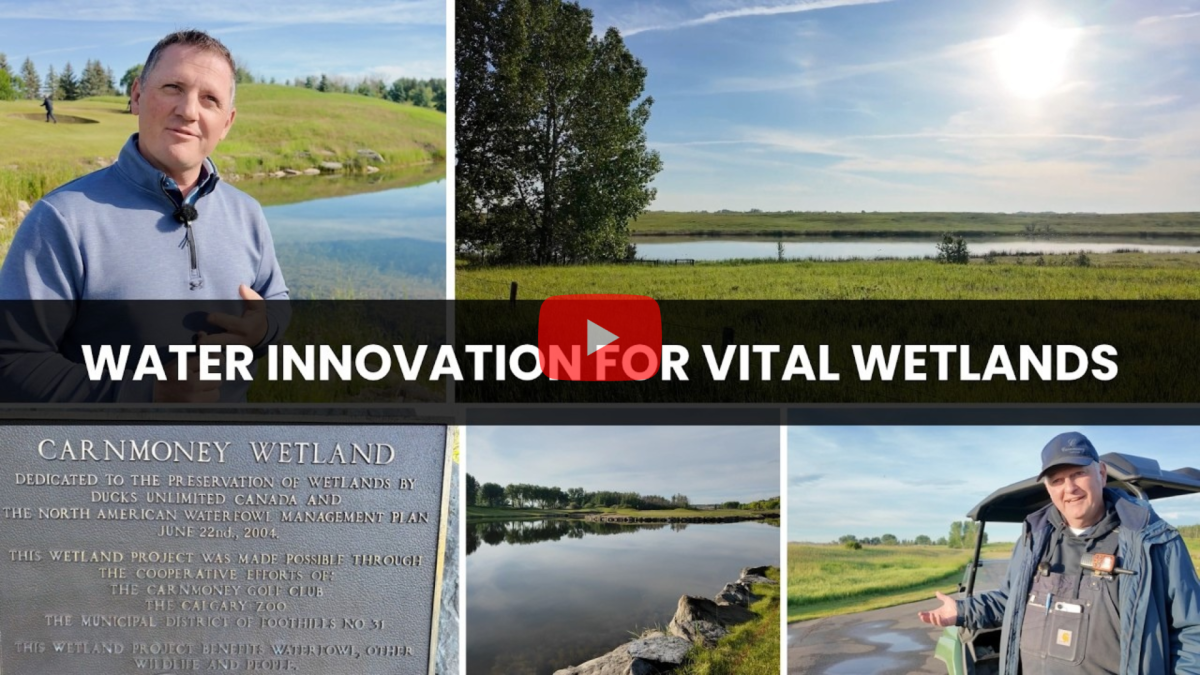
Watch: The Green Report at Carnmoney Golf Club, Canada
While many golf clubs are trying to save water, Carnmoney Golf Club in Calgary, Canada, faces the threat of too much. In the latest episode of The Green Report docuseries, host Gary Firkins discovers how the club manages floodwaters to protect its course and the surrounding wetlands.
Situated beside the Bow River, Carnmoney was permitted for construction in the early 1990s on the condition that it would enter a permanent legal obligation to manage water levels for the benefit of local wetlands. More than two decades into a partnership with Ducks Unlimited Canada, the country’s foremost wetland conservation organization, the club now uses a network of interconnected ponds and purpose-built flood measures to control water levels, protect wildlife habitats and deliver high-quality playing conditions.
How did Carnmoney’s partnership with Ducks Unlimited Canada begin?
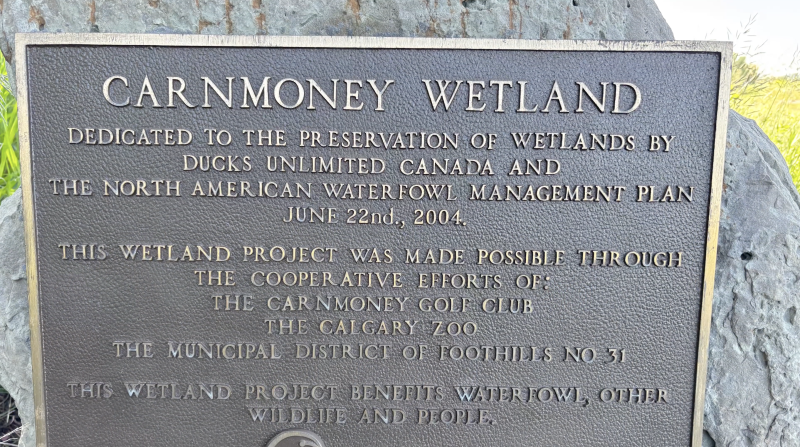
For retiring General Manager Patrick Coli, the partnership is one of the club’s proudest achievements. The wetlands on Carnmoney’s eastern border were laid out in the early 2000s through a joint agreement with Ducks Unlimited Canada, which built a large clay dam to hold water on neighbouring land owned by the Calgary Zoo. The club was a major participant in the project.
“Ducks Unlimited are probably the leading conservationists in Canada,” says Coli. “We were lucky enough to have them participate with us.”
The relationship continues today through a practical, year-round agreement: the club adds water to the wetland when levels are low and removes it when they rise too high.
The idea also had strong support from the start. When the proposal was put to members in the early 2000s, they backed it.
“Our members in general, and I believe golfers in general, are very much stewards of the environment,” says Coli. “Our members are on board all the time, and they love it.”
How does Carnmoney’s innovative, interconnected pond system work?
Out on the course, Superintendent Cameron Kusiek explains how water travels across the property. From the Ducks Unlimited pond to the north, and a second large pond on former zoo land to the south, water flows through a valley into a ravine that forms part of the back nine. From there, subsurface drainage and a natural corridor carry it on to the Bow River.
“When you build a golf course, you can’t stop water from taking its natural path,” says Kusiek.
Rather than simply holding water in place, Carnmoney’s system keeps it moving.
That approach shapes how the ponds are managed. Because every pond is connected, and the bottom pond overflows its weir into the Bow River when levels are high, the club does not use algaecides or any other pond treatments. Anything added to the water could leave the property, so keeping the ponds untreated protects the river downstream.
How did Carnmoney solve flooding on the course?
Assistant Superintendent Robbie Moore explains that one area sat in a natural collection point with a high water table, leaving a fairway bunker too soft and regularly filling with water.
The solution came through the collaboration with Ducks Unlimited Canada. A raised mound was first built in the previously flat area, and the space behind it gradually became a pond. When the water rose above the level of the neighbouring fence, Ducks Unlimited installed a valve system that directs water into one of the club’s ponds, where it can be pumped away.
“It’s been pretty beneficial for both,” says Moore. The new pond has also become a haven for ducks and other waterfowl.
What wildlife lives at Carnmoney Golf Club?
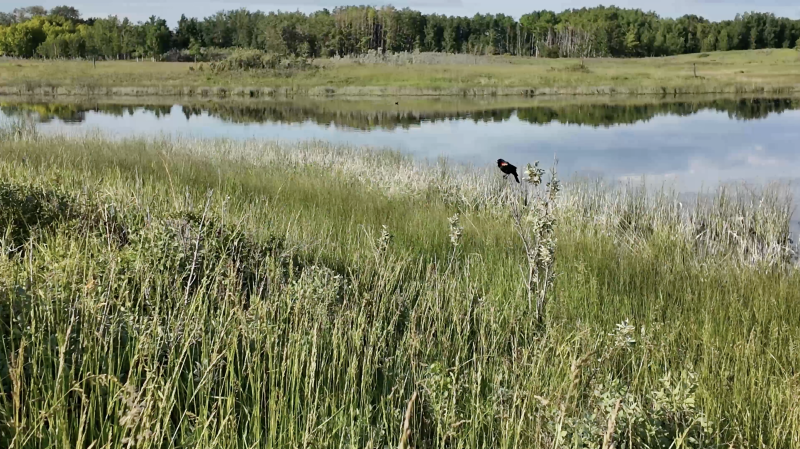
For Moore, early mornings on the course are a reminder of how much life the wetlands support. Geese and ducks are regular visitors, swans appear from time to time, and coyotes and other predators hunt the geese. It is, as host Gary Firkins observes, all part of a thriving ecosystem.
How do interconnected ponds benefit turf and playing conditions?
For Kusiek, the environmental benefits go hand in hand with better golf. Constantly flowing water stays clean and oxygenated rather than stagnant, which makes it better for irrigation as well as for wildlife.
“The best way to design a golf course, if possible, would be to interconnect your pond system so that they’re constantly flowing,” he says. “It’s constantly oxygenated, which is good for the turf. Ultimately, I’m a turf manager. We do take care of the environment, but we have to create a golf experience, and we want to make the best playing surface possible. Irrigation is a big factor in that.”
He acknowledges that not every course has the natural setting to do the same. His advice is simple, though: any club installing multiple ponds should ask whether they can be connected.
Why are wetlands so important?
Worldwide, wetlands provide rich wildlife habitats and store around a third of the world’s soil carbon. They also help reduce the effects of drought and flooding, a role that becomes increasingly vital as urban areas expand, as they continue to do around Calgary.
At Carnmoney, that protection also helps secure the club’s future. The Ducks Unlimited wetland sits on land owned by the Calgary Zoo, which could one day be sold to developers. Because the wetland must remain, any future development would have to work around it. That is likely to keep housing away from the course’s edge and preserve the golf experience.
What can other golf clubs learn from Carnmoney?
Carnmoney’s story shows what is possible when a golf club works with its landscape rather than against it. By following the natural path of water, connecting its ponds and partnering with conservation experts, the club has turned a legal obligation into a long-term conservation success, with the support of its members.
“This is a story of water stewardship and collaborative conservation,” says Firkins.
“The interconnected water system here is an innovative solution. It is simple, yet effective. Carnmoney’s team delivers five-star playing conditions with real professionalism, yet, as Kusiek himself says, greenkeepers are at heart naturalists. At a time when golf courses are often judged negatively, Carnmoney is telling a different story.”
Whether a course is managing too much water or too little, the same principles apply. Explore more practical solutions in our feature, How Golf Can Become Water Sustainable.
Watch the full episode
Watch the Carnmoney Golf Club episode of The Green Report on YouTube
About The Green Report
The Green Report is Syngenta Golf’s docuseries exploring environmental stewardship and innovative course management across the globe. Through candid conversations with superintendents, sustainability experts, and environmental professionals, each episode examines key industry challenges, such as water management and habitat conservation, while showcasing real-world solutions in action.